

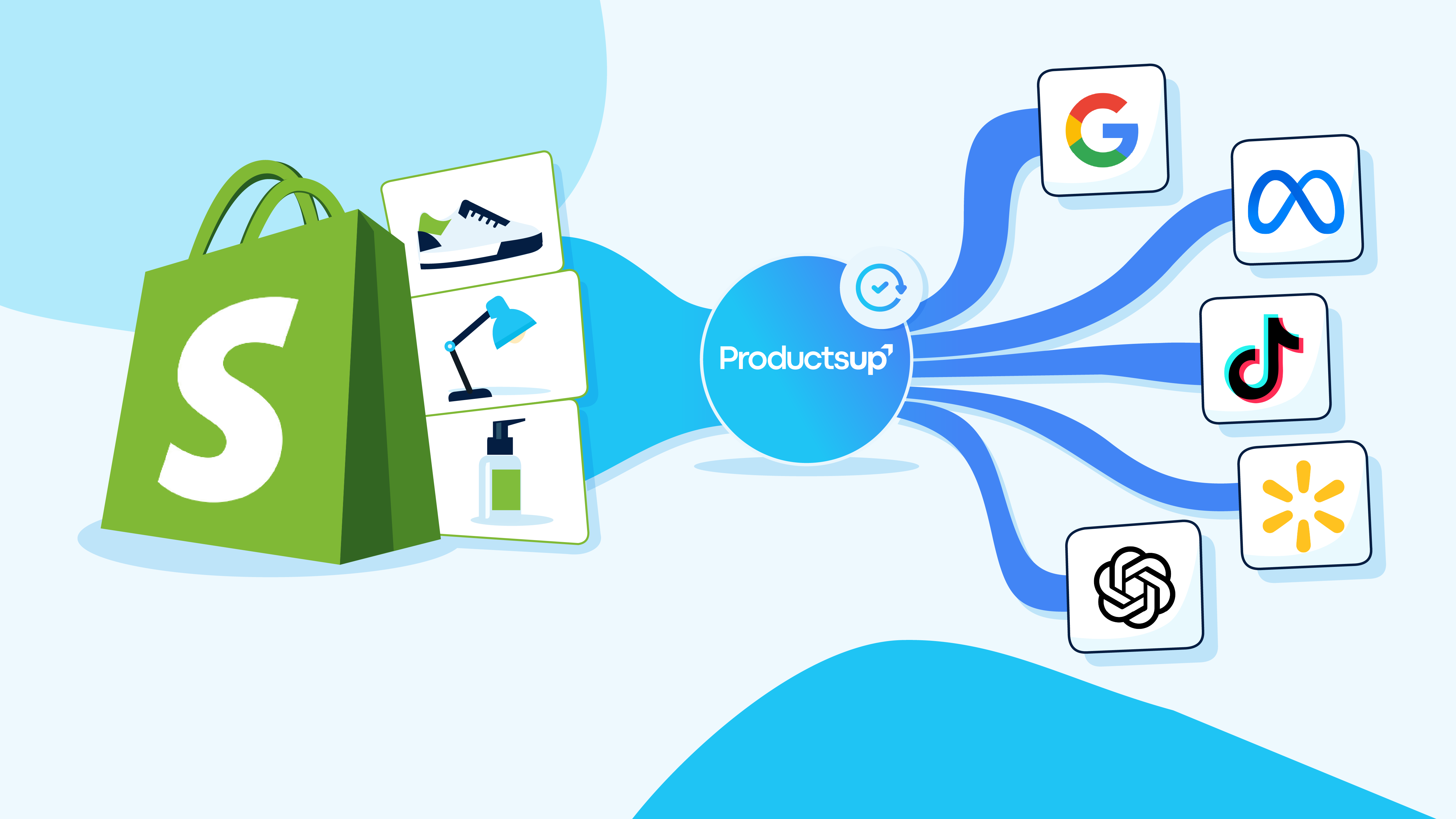





Shopify powers millions of businesses in more than 175 countries, and in the second quarter of 2026 alone, its merchants sold $115.6 billion in gross merchandise volume, up 32% year over year.
Shopify also makes it easy to sell beyond your store. Its Marketplace Connect app helps merchants list products on Amazon, Target Plus, Walmart, and eBay, while sales channel integrations connect Shopify catalogs to Google Shopping, Pinterest, YouTube, Facebook, Instagram, and TikTok.
For enterprise brands, though, those channels are rarely the full list. Shoppers compare products on OTTO and Bol in Europe, buy from retailer marketplaces such as Macy’s, and ask ChatGPT what to buy. To reach those shoppers, your catalog has to go beyond Shopify’s own channels.
However, with thousands of SKUs, multiple markets, and constantly changing product information, every new destination expects its own requirements for product titles, attributes, categories, pricing, and availability. Keeping that information accurate and consistent across channels takes ongoing work.
A good AI-powered and automated product feed management and syndication platform helps streamline these processes, keeping product information consistent and channel-ready at scale.
Why does marketplace expansion at scale require more than native Shopify sales channels?
Before getting to the how, it’s worth looking at why native Shopify channels stop being enough.
Shopify Marketplace Connect simplifies listing and inventory management across its four supported marketplaces. But expanding to additional channels may require separate integrations or manual work. The bigger challenge is adapting a single Shopify catalog to each platform’s specific requirements:
Every marketplace has its own data set: To reach wider audiences on platforms like OTTO, Kaufland, ManoMano, or Mirakl-powered marketplaces such as Macy’s, you must meet their specific product feed specifications. Shopify can store extra product data in metafields, but that data is structured for your storefront, not for each marketplace’s schema. As a result, configuring product data to align with the unique, mandatory attribute requirements of each platform requires manual effort for every channel.
Variants add complexity: Sizes, colors, materials, styles, genders, and bundles are grouped differently on every marketplace. Product variant setups that operate seamlessly inside Shopify often must be reconfigured to meet the demands of other sales channels.
Localization multiplies the work: Shopify Markets handles localization well for your own storefront, and Marketplace Connect converts currencies across marketplace regions. However, regional marketplaces outside Shopify's native ecosystem demand translated, localized content formatted to their specific schemas, a workload that grows with every new region.
Inventory sync and overselling risks: Expanding beyond Shopify’s supported marketplaces may require additional integrations, each with its own inventory synchronization process. Without consistent stock updates across channels, businesses risk inventory discrepancies, overselling, and order cancellations that can negatively affect marketplace seller performance.
Listing errors are harder to track: Every marketplace unpublishes, suppresses, or rejects listings that fail its data checks. For instance, Walmart marketplace unpublishes items missing a primary image or price. The problem is that each marketplace reports these errors in its own seller portal, in its own format. Your team has to check every portal separately to find out what went wrong, and with dozens of channels, issues often go unnoticed until sales drop.
Expand your reach across global marketplaces using Productsup
See how Productsup syndicates your Shopify catalog to leading marketplaces like Amazon, Walmart, OTTO, and Mirakl-powered marketplaces.
Book a demo →How do you sync one Shopify product catalog to every marketplace?
To overcome channel limits, reduce manual work, and streamline distribution, you need a centralized engine that connects directly to Shopify to automate catalog syndication. Productsup acts as that intelligent layer, integrating with your Shopify ecosystem to map, optimize, and syndicate your entire catalog across global channels. It sits between your Shopify store and the channels you want to reach, and works in four steps:
1. Import your Shopify catalog
Productsup connects to your store through the Shopify GraphQL Admin API and pulls in your entire product catalog. It imports everything from descriptions and images to prices, inventory, and categories, ensuring consistent synchronization for large catalogs with minimal intervention from your team.
In addition to this, Productsup can import product data from other systems through files, APIs, and direct connectors. Therefore, data from a PIM or ERP sits alongside your Shopify catalog. This ecommerce data integration matters because marketplaces often require attributes your Shopify store usually doesn’t store.
2. Transform and enrich for each marketplace
After the data is imported, rule boxes modify attribute data so you can map categories, rewrite titles, and restructure fields for each marketplace. With rule box conditions, a change applies only when set criteria are met, for example, to one category or market.
AI Enrich then fills the gap by generating missing or weak attributes, such as product highlights, in bulk across thousands of SKUs.
3. Check export readiness for each marketplace
Before your Shopify catalog goes to Amazon, OTTO, or any other marketplace, Productsup's Analyzer Tests check it against that marketplace's requirements. Exports with Analyzer Tests also show two scores. The readiness score shows what percentage of your products meet the marketplace's mandatory requirements. The optimization score also counts optional attributes. When a test fails, you can apply the rule box that Productsup suggests and fix the data before it reaches the marketplace.
4. Syndicate, monitor, and automate order and inventory updates
Once your Shopify catalog is imported and optimized, you can connect marketplace accounts like Amazon, eBay, Walmart, or OTTO to Productsup. Authorizing access is a one-time setup that enables centralized marketplace feed management.
On every scheduled run, it fetches updated data from Shopify, applies your rules, and automatically updates all connected channels without manual effort.
Additionally, marketplaces may reject listings due to missing attributes or invalid values. Productsup helps teams identify and resolve these errors centrally, without checking each seller portal. Productsup offers Export Feedback, which monitors your marketplace exports and collects the errors that eligible marketplaces report, such as missing attributes or invalid values, in one dashboard.
To reduce stock discrepancies and overselling, Productsup can receive Shopify product updates and distribute updated inventory and pricing data to connected channels on subsequent runs. Productsup also supports order imports and shipment updates for compatible marketplaces, helping teams manage listings and order data from one platform.
Push your Shopify catalog to 2,500+ channels with Productsup
Sync your full catalog and orders, and keep listings updated across all your marketplaces and channels from one platform.
Explore Shopify Integration →Can the same Shopify feed power ads, comparison sites, and AI shopping?
Yes. The same Shopify catalog can serve as the foundation for marketplace listings, advertising feeds, comparison shopping sites, and AI shopping channels. Once your product data is cleaned and enriched, you can adapt it to destinations like Google Shopping without rebuilding the feed from scratch. Emerging AI shopping platforms may require additional data formats and integrations, but the same product data foundation can support them.
Ads, social, and comparison platforms
Each advertising platform needs to see your catalog a little differently. For example, Google’s Performance Max campaigns tend to perform better when titles lead with the product type and custom labels separate your best sellers from clearance stock.
On Pinterest, you might choose to promote only a specific collection, such as home décor. Channel-specific rules let you tailor product data and select which products to distribute, without changing your original Shopify catalog.
How does Productsup help?
The same rule boxes that adapt your marketplace data also shape your Google Merchant Center feed, Pinterest feed, and Microsoft Shopping feed.
Since ads and social feeds are highly visual, the product image often decides whether a shopper stops scrolling. Image Designer helps here by adding prices, ratings, or promotions to your product images directly from the feed, so they update automatically when your data changes.
For comparison sites, especially if you sell in Europe, dedicated integrations handle the specific requirements of idealo and Kelkoo. And if you have physical stores, Google Local Inventory Ads let you show nearby shoppers what’s available in-store.
AI shopping assistants
Through agentic storefronts, Shopify already makes eligible stores’ products available in ChatGPT, Microsoft Copilot, Meta Muse (for stores selling to U.S. buyers), and is rolling out Google AI Mode and Gemini. But being listed isn’t the same as being recommended. When a shopper asks an assistant for advice, it suggests the products it understands best, and product data is one of the signals it relies on, and it’s the one you control.
How does Productsup help?
Productsup supports AI shopping channels by helping brands enrich and distribute product data. Features such as AI Enrich can generate product highlights, Q&A pairs, and use-case tags that provide additional context about products.
For platforms like Gemini and Google AI Mode, these details feed directly into Google’s conversational attributes via a tailored Google Merchant Center export, aligning with the functionality Google introduced in May 2026.
Productsup also offers integrations for distributing product catalogs to ChatGPT for shopping and Glance. These allow brands to extend their existing Shopify product data to emerging AI shopping channels, subject to each platform's requirements and eligibility criteria.
Is your catalog ready for AI shopping assistants?
Find out how Productsup turns thin product data into agent-ready data with Q&A pairs, highlights, and use-case tags that ChatGPT, Gemini, and other AI channels can understand and recommend.
Explore AI Enrich →Productsup vs. native Shopify sales channels vs. third-party feed apps
Shopify's native sales channels, third-party feed apps, and Productsup all help distribute product data, but they differ in channel coverage, customization, and management capabilities.
Here's how they compare.
| Productsup | Native Shopify sales channels | Third-party Shopify feed apps | |
|---|---|---|---|
| Channel coverage | 2,500+ channels, including marketplaces worldwide, retailer and distributor sites, ad and social channels, comparison sites and AI shopping channels | Google, YouTube, Facebook, Instagram, TikTok and Pinterest through sales channel apps, plus Amazon, eBay, Walmart and Target Plus through Marketplace Connect (Walmart and Target Plus in the U.S. only); OTTO, Kaufland, Bol and Mirakl-powered marketplaces not included | Varies by app; some focus on advertising, while others support multiple marketplaces. |
| AI shopping and visibility | Enriched product data for AI shopping channels, with weekly dashboards showing how your brands and categories appear in AI assistants | Agentic Storefronts make eligible products available in AI channels, with a search preview of how products might rank, listing quality insights, top search queries and performance reports; ChatGPT and Copilot only for stores selling to U.S. buyers | Depends on the app. |
| Product data management | Rules that apply to every channel at once or to one channel only, with conditions, product segments and bulk copying across stores or markets, plus AI-generated attributes | Product data managed in Shopify and synced to each channel; per-channel changes limited to what each app's settings allow | Rule-based edits per feed, such as title templates, custom labels, and filters. |
| Data sources | Combine Shopify data with PIM, ERP, supplier feeds, and other sources. | Your Shopify catalog only; data from other systems must be synced into Shopify first | Primarily Shopify, with additional sources supported by some apps. |
| Feed monitoring | Validation tests before export, with errors from eligible channels collected in one dashboard | Sync status and errors shown separately in each channel app, plus listing quality insights for AI channels | Error checks in each app, so brands using several apps check each one separately |
| Best for | Enterprise brands and agencies selling across many marketplaces, markets, and channels. | Brands selling through Shopify’s supported marketplaces, ad channels, and AI channels | Brands with specific channel needs. |
Scale your Shopify catalog across markets with Productsup
Your Shopify store is just one place customers discover and buy your products. Expanding to new marketplaces, retailers, and shopping channels creates more opportunities to reach them, but also means managing different product data requirements.
With Productsup’s Shopify integration, you can distribute your catalog across channels without managing separate feeds manually. Product information flows from Shopify to your connected destinations, and because the rules you build once carry over to every new export, your next marketplace starts from a catalog that’s already prepared.
That’s how Productsup simplifies enterprise catalog management for brands expanding their reach and multi-client agencies alike.
👉 Book a demo to see how your Shopify catalog would perform across the channels you’re planning next!
FAQs
With Productsup, one Shopify feed can reach Amazon, Walmart (in the U.S.), eBay, and more marketplaces, including OTTO, Kaufland, and Bol, which Shopify's Marketplace Connect doesn't cover. Productsup does this in four steps: it imports your Shopify catalog, optimizes it for each channel, checks it against each marketplace's requirements, and sends it through a separate export for each channel. After setup, every scheduled run repeats this automatically.
Yes, you can localize your Shopify catalog for European marketplaces with the help of Productsup. Rule boxes apply separately to each marketplace export, so OTTO, Bol, and ManoMano can each receive titles, descriptions, currencies, and category data in their own format and language, using the localized data you maintain in Shopify or a PIM.
Connect your Shopify store to a product content syndication platform such as Productsup, then send each retailer your catalog in the format it accepts: 1. Import your Shopify catalog through the Shopify Admin API. 2. Map your attributes to each retailer's content requirements. 3.Export to every retailer on a schedule, from the same catalog. .
Keep one source catalog and add each new marketplace as another export from it. In Productsup, the rules and enrichment you've already built carry over, so a new marketplace only needs its own mapping on top. The existing listings on marketplaces like eBay and Amazon can be imported or reused instead of recreated.
About the author
