

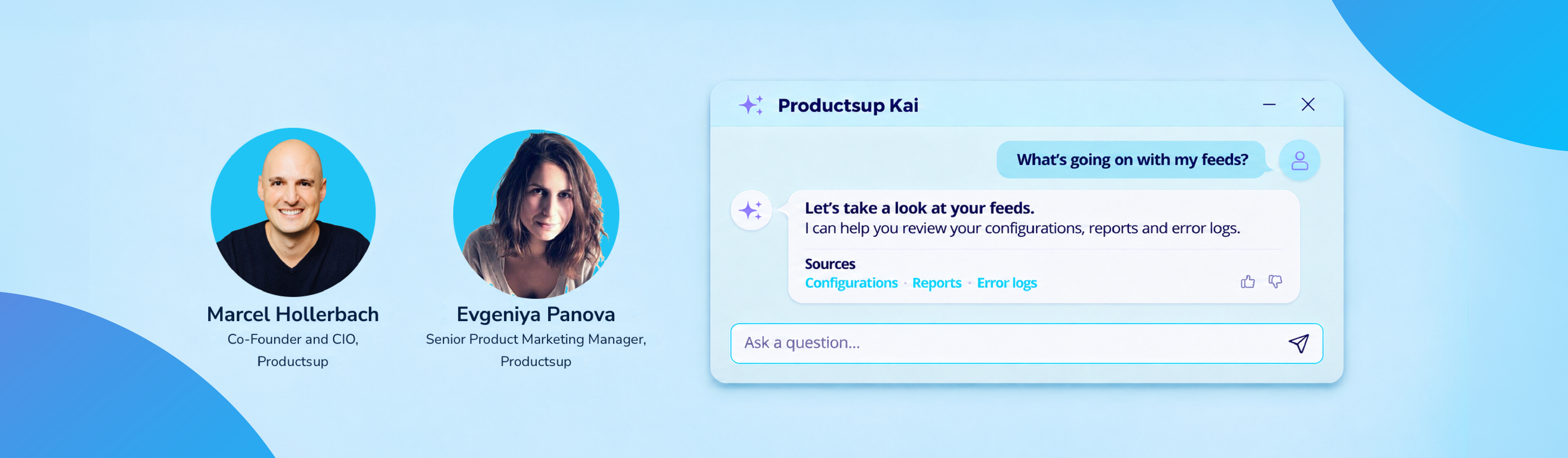
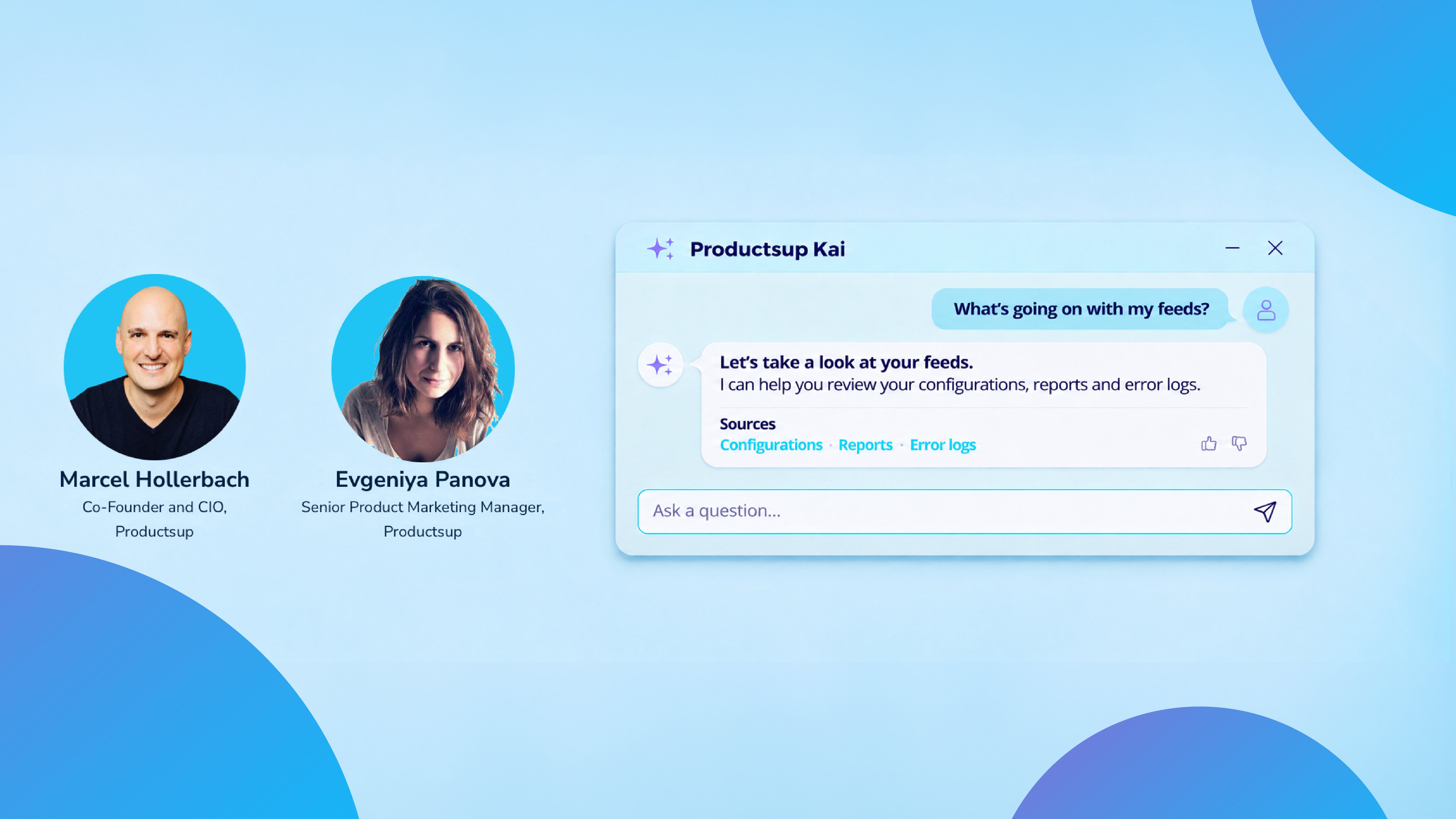





“Hey Productsup, what's going on with my feeds?”
It takes seconds to ask the question but extensive resources to find the answer.
We're building Productsup MCP to change that. It all starts with Productsup Kai, our in-platform AI assistant, which will be able to understand our customers’ feeds to provide guidance based on their actual setup through natural conversations.
I sat down with our Chief Innovation Officer, Marcel Hollerbach, to get his take on where our MCP roadmap is headed in 2027.
1. Why is Productsup investing in MCP, and what does it mean for the future of the platform?
“AI is changing how businesses work, and we want our customers to benefit from that shift. We've spent years building Productsup to help businesses manage complex product data operations at scale. With unlocking MCP on our platform, we're building on that foundation to make feed management truly agentic.
And that's really what excites me. As AI becomes part of everyday business operations, we want Productsup to evolve alongside our customers. It's about giving them more flexibility, more ways to work with the platform, and the freedom to bring Productsup into their broader AI workflows.”
2. In talks with our customers, what's the one feed management headache you wish you could make disappear overnight?
“Haha, just one? Well, I'd say it's the time teams spend figuring out what's going wrong with their feeds. Our customers manage huge catalogs across dozens of channels and markets, and even a small issue can take time to investigate. With our MCP-powered agent Kai, we will make that process easier. Customers can ask questions about their actual setup, understand what's happening, and figure out what to do next without spending too much time investigating.”
3. Most of us have used some type of AI assistant by now. What makes Productsup agent Kai different?
“The biggest difference is context. A general AI assistant can explain how feed management works, but it doesn't know how your Productsup environment is configured.
With MCP, our own agent Kai will be able to access selected information from your actual setup, including configurations, reports, and error logs. It also knows the Productsup best practices and the best ways of implementation. So instead of getting generic advice, you’ll be able to ask questions about your own feeds and get answers that are relevant to your operations.
And we're doing this within Productsup's existing permissions and security framework, which is especially important for enterprise customers.”
4. What can customers expect from Productsup's agent running on MCP in the coming months?
“We're taking a phased approach. First, we're bringing MCP-powered read access to Kai, so customers can ask questions about their actual Productsup setup and get guidance on what to do next. For example,
- “Why did some of my products fail to export to Google Merchant Center?”
- “Help me understand which mapping rules I should review to fix incorrect product categories in my Google Shopping feed.”
- “Which required product attributes are missing according to my latest readiness report?”
From there, we plan to introduce controlled AI-powered actions, allowing customers to make supported changes through Kai. And the end goal is to extend these capabilities to external AI agents like Claude.
We're starting with a controlled rollout because it's important that we build this responsibly, especially when customers are managing business-critical product data operations.”
5. If AI can tell us what's wrong with a feed, why can't we just ask it to fix everything? 😉

“Hahah.. The tricky part is knowing what to change and understanding what that change might affect. A mapping adjustment that fixes an issue for one channel could create problems for another. And when you're managing millions of products, you can't take that risk lightly. That's why we're starting with Read Access. Kai can help customers investigate issues and understand next steps while they stay in control of changes.
As we move toward AI-powered actions, we'll need the right permissions, safeguards, and oversight in place. We want AI to help customers solve problems faster, but we also want them to trust every action it takes.”
6. How are customer expectations changing as AI becomes part of their commerce operations?
“One thing we're hearing more often is that customers want AI to work with the technology they've already invested in. They're looking at how they can connect their systems, make better use of their data, and bring AI into their existing workflows.
And that's an important shift for us. Customers have different AI strategies, so we want to give them the flexibility to build on Productsup in a way that works for their business, whether that's through Kai or eventually by connecting Productsup to the AI tools they already use.”
7. Fast-forward to 2027. How do you see the role of feed managers evolving as AI becomes part of their everyday work?
“I think feed managers will have more opportunities to focus on the work that really moves the business forward. Feed management will become more like campaign management. You still need expertise in product data, channel requirements, and commerce operations, but AI can help take some of the repetitive work off your plates.
I see the role becoming more strategic, with greater focus on improving product data quality, exploring new channels, trying out campaign ideas, investing in enrichment, and making decisions that drive growth.
And if all goes well, by 2027, feed managers might finally have time to enjoy their coffee while it's still hot. That's a pretty good KPI, if you ask me.”
Well, here's hoping for fewer feed headaches and more hot coffees in 2027! ☕
With unlocking MCP on the Productsup platform, we're opening up new possibilities for how teams interact with their product data, starting with contextual answers through Kai and moving toward controlled AI-powered actions.
And we're just getting started.
Curious about what's next? Explore Productsup MCP and see where we're heading.