






Your product data was built for feeds, marketplaces, and search. Now AI agents need to understand it too.
Shoppers are increasingly using AI assistants such as ChatGPT, Perplexity, Gemini, or Copilot to compare products, narrow choices by budget, model, or color, explain which option best fits their needs, and move closer to purchase.
The numbers show how quickly this behavior is growing. Use of AI applications has risen 62% over the past two years, and 41% of consumers now use them to research products. Additionally, agentic search alone grew 200% year over year as the first step in a purchase journey. Over the same period, product discovery through brand-owned properties fell 7%, and traditional search fell 15%, globally.
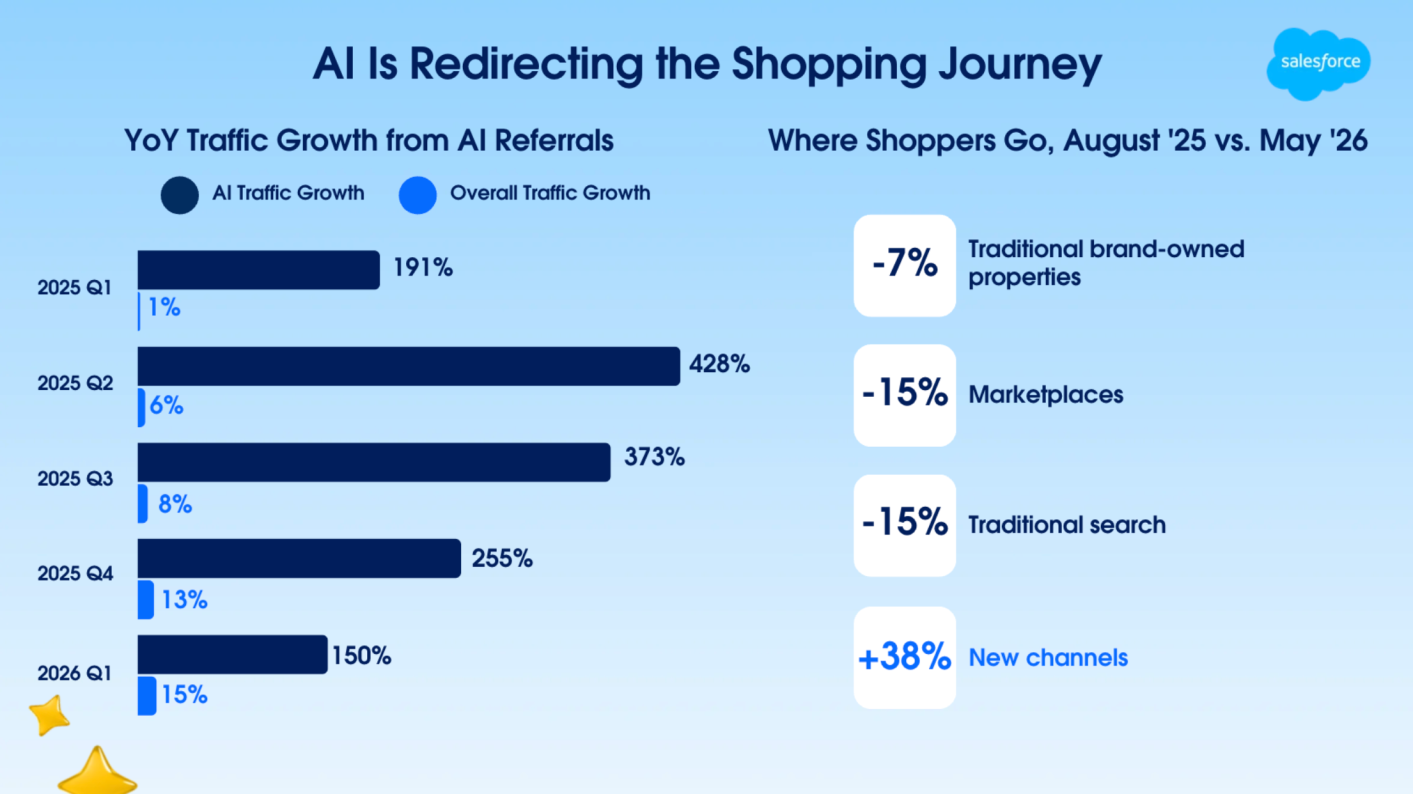
As AI-led shopping grows, commerce platforms are giving AI systems more direct access to merchant product data. For example, Google’s Universal Commerce Protocol (UCP) allows agents to retrieve current product details, pricing, and availability, while Microsoft is expanding Copilot’s commerce capabilities across its ecosystem.
For enterprise brands or retailers, this puts product data at the center of agentic commerce readiness. An agent needs enough machine-readable product data, structured information to identify the right product, distinguish variants, confirm local availability, and explain why an item matches a shopper’s request.
The following seven steps will help you prepare large, multi-market catalogs for AI-driven discovery and agent-led shopping.
Evaluate your catalog for agentic-ready product data
If your product data already performs well across Google Shopping, marketplaces, and Meta ads, you might assume it is ready for agentic commerce too. But it isn’t necessarily. Agentic platforms consume data differently; they evaluate a catalog to answer a specific question, compare it against alternatives, and confirm the offer is valid for that shopper's market and budget.
Thus, data gaps like missing return policies, missing variant availability, or price mismatches can cause AI agents to skip your product. For enterprise catalogs spanning millions of SKUs, markets, and channels, maintaining that level of completeness and consistency becomes even more challenging.
The checks below show whether your product data is ready for agentic commerce and where it needs work. Run them against your catalog as it stands today, then use the gaps you find to prioritize improvements.
Check 1: Can every sellable item be uniquely identified across your systems?
An AI agent has to recognize that the item in your feed, on your product detail page, and in your inventory system is the same product. It also needs to understand how individual SKUs relate to a parent product and to other variants within the same product family.
For large catalogs, that gets harder when identifiers differ between the ERP, PIM, storefront, and channel feeds, or when parent-child relationships aren't consistently defined.
Check whether your product data meets these requirements:
Product identity is the foundational anchor for all AI platforms, making this step the essential starting point for agentic commerce readiness.
Optimize product data for agentic commerce with Productsup AI Enrich
Generate product highlights, Q&A pairs, use cases, and differentiators at scale, with your team approving every change before it goes live.
Explore AI Enrich →Check 2: Does every sellable item contain the information an AI agent needs to evaluate it?
An agent cannot recommend a product just from title and price fields. It needs enough factual information to match the item to a shopper’s request and distinguish it from similar products. That means providing both the core product data and category-specific attributes an agent needs to evaluate the item.
Run these checks to ensure AI can evaluate products:
Check 3: Do price, availability, and promotions match across every customer-facing platform?
An agent may use the product feed to identify an item, but it also needs current offer information before recommending it to the shopper. If price, availability, or sale dates differ across the product feed, product detail page, structured data (JSON, XML, or CSV format), and checkout, the agent cannot reliably assess whether the product matches a shopper’s budget or can be delivered.
Check your product data against these conditions:
Is your product data ready for AI shopping?
See how Productsup helps you prepare and distribute product data for AI channels, including ChatGPT.
Explore AI Channels →Check 4: Can an agent understand shipping, returns, and other purchase terms?
Price and availability alone do not tell a shopper whether an offer works for them. Delivery timing, shipping cost, return eligibility, restocking fees, and product restrictions can change the buying decision, especially across markets.
Your product feed data must pass these checks for agentic commerce readiness:
💡Remember this rule of thumb: If important purchase terms are difficult for a shopper to find, they may also be difficult for an AI agent to reliably interpret and use.
Check 5: Can your catalog support conversational product discovery?
AI agents match natural-language questions to structured attributes and not only to keywords in a title. If your data contains only technical specifications and marketing material, an agent can list the product but cannot explain why it fits a user’s specific need.
Check whether your product data meets these mandatory requirements:
Check 6: Is your product data localized and eligible for each target market?
For global catalogs, product relevance depends on more than translating a description or converting a price. AI agents also need accurate market-level information to determine whether a product is available to a shopper and whether the offer, content, and conditions apply in that location.
Verify your catalog’s AI readiness by measuring your product data against the following criteria:
See how enriched product data, with highlights, Q&A, use case tags and differentiators, gives AI more to work with than a basic listing.
Download the guide →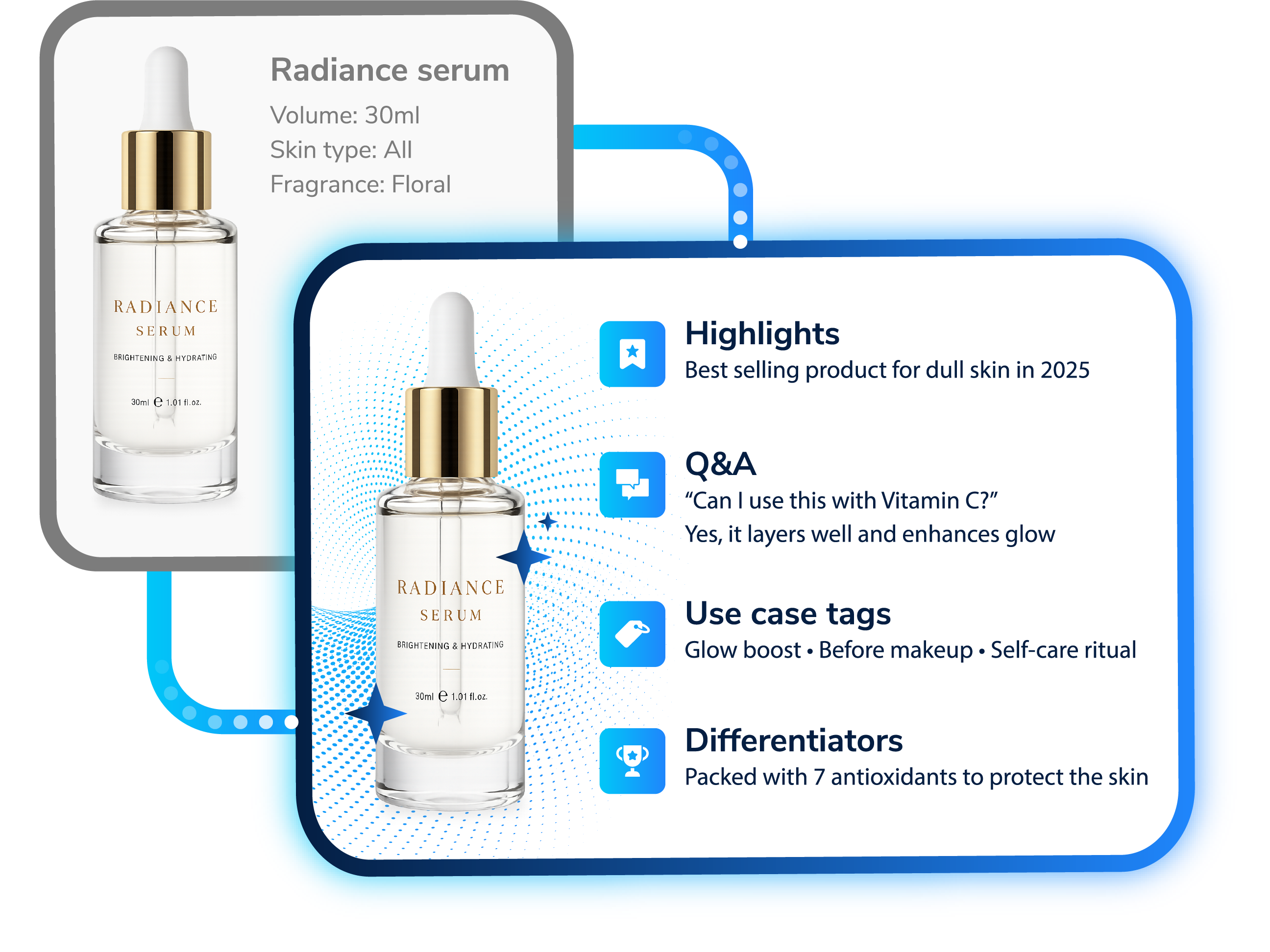
Check 7: Do you have a governed publishing and monitoring process for AI channels?
Agentic channels change faster than traditional marketplaces, because LLMs are currently in an evolving state. New feed specifications, attribute requirements, and policy rules appear regularly, and a catalog that is “ready” today can drift out of compliance within weeks if there is no process to track errors, disapprovals, and visibility.
Agentic commerce readiness therefore needs an ongoing process for publishing, validation, monitoring, and improvement.
To avoid this, you need to check the following:
Turn AI visibility gaps into product data improvements with Productsup
See where your products appear across AI platforms, compare visibility with competitors, and identify where your product data needs work.
Try AI Visibility now →Keep product data agentic-ready at enterprise scale with Productsup
Running these seven checks once is straightforward. However, keeping them true across thousands of SKUs, multiple markets, and rapidly changing agentic platforms is not. Feed specifications, attribute requirements, and policy rules of AI channels evolve regularly, and manual audits and spreadsheet fixes cannot keep pace without creating data debt.
Productsup helps enterprise teams manage that process at scale. Bring product data together from PIMs, ERPs, DAMs, ecommerce platforms, supplier sources, and other systems; standardize and enrich it; adapt it to channel requirements; and distribute machine-readable product data across marketplaces, retail media, social commerce, and emerging AI channels.
You can also enrich product content with AI-generated highlights, Q&A pairs, use cases, and other contextual attributes, with human review built into the workflow.
Book a personalized demo today to see how Productsup can help prepare and manage your product data for agentic commerce.
FAQs
Yes, schema markup improves a product feed’s AI visibility as it helps translate data for agentic shopping platforms. It adds machine-readable clarity, attribute richness, disambiguation, and trust, and supports server-side execution such as JSON-LD structured data.
Optimizing product data for AI agents increases the likelihood that your products are surfaced, accurately compared, and recommended in AI-led shopping experiences. It improves visibility across AI platforms, reduces the risk of being excluded due to missing or conflicting data, and ensures that price, availability, and purchase terms are correct when an agent evaluates your offer.
Live data improves AI discoverability by ensuring that agents see current prices, stock levels, and promotions when they evaluate products. If an agent retrieves outdated availability or pricing, it may skip your item, recommend a competitor, or present an offer that fails at checkout. Real-time or frequently refreshed data signals reliability to AI platforms and helps your products remain eligible for recommendation.
About the author
