





Key takeaway: Test your product data changes with Feed Experimentation
- Productsup’s brand new feature, Feed Experimentation, allows brands to test changes to product data on a controlled subset of products before deploying them across the entire catalog.
- Teams can validate AI-generated descriptions, product titles, pricing strategies, custom labels, and other feed attributes using performance data rather than assumptions. Image-based tests can also be supported through the Productsup Image Designer tool, enabling brands to compare different visual approaches at scale.
- Built on Productsup rule box conditions, Feed Experimentation enables precise audience segmentation for more meaningful and actionable results.
- Combined with Productsup AI Data Services and AI Enrich, this feature helps brands enrich, test, optimize, and syndicate product data across the commerce ecosystem.
Feed optimization has always involved an element of uncertainty.
Whether teams are refining product titles, enriching product content with AI, testing new imagery, or adjusting feed structures for advertising channels, the challenge remains the same: understanding the impact before rolling changes out at scale.
To help brands make more informed feed decisions, Productsup recently launched Feed Experimentation. Built directly into the platform, Feed Experimentation allows teams to test feed changes on a controlled subset of the product, measure performance with existing analytics tools, and scale only what works.
As product data becomes increasingly important for advertising performance, marketplace visibility, and AI-powered product discovery, experimentation provides a practical way to reduce risk, improve decision-making, and maximize the return on feed optimization efforts.
Yet many brands still approach feed optimization as a one-way process: make a change, publish it, and hope for the best.
At enterprise scale, that approach can become expensive.
🚀 New: Productsup Feed Experimentation
Feed optimization shouldn't rely on intuition alone. Feed Experimentation enables ecommerce teams to compare product data variations and uncover the impact of individual changes. See how now!
Learn moreThe hidden cost of "just making the change"
Feed optimization is often treated as a simple, low-risk activity.
✅ Update a title
✅ Rewrite a description
✅ Add new images
✅ Launch a new AI enrichment workflow
But at enterprise scale, even small feed changes can influence:
- Product visibility
- Click-through rates (CTR)
- Conversion rates
- Return on ad spend (ROAS)
- Marketplace performance
- AI-driven product recommendations
When a feed update goes live across the entire catalog, it's difficult to determine whether the change improved performance or made it worse. If ROAS drops, identifying the root cause becomes a lengthy investigation. If performance improves, it's often unclear which optimization drove the result.
The challenge becomes even bigger with AI
Many brands are actively investing in:
- AI-generated product descriptions
- Product highlights
- Attribute enrichment
- Automated taxonomy mapping
- Channel-specific content generation
But before approving a broader rollout, stakeholders typically want evidence that the change will deliver value.
❓Will AI-generated descriptions improve conversion rates?
❓Does a different title structure increase click-through rates?
❓Are lifestyle images outperforming studio photography?
These questions are difficult to answer without a structured testing framework.
Feed experimentation allows teams to test changes before committing to a full rollout, reducing wasted spend and making decisions backed by performance data rather than assumptions.
In practice, that means:
✅ Lower risk when introducing feed changes at scale
✅ Faster validation of AI-driven initiatives
✅ Improve ROAS and campaign efficiency
✅ Better allocation of advertising budgets
✅ Greater visibility into winning feed strategies
✅ Build stakeholder confidence with measurable results
Feed Experimentation: Built for modern feed optimization
To help brands move beyond assumptions, Productsup Feed Experimentation brings controlled testing directly into the feed management workflow.
Instead of applying changes across an entire catalog, teams can create experiments on a defined product subset, compare two variations, and measure the impact before making broader rollout decisions.
Unlike traditional approaches that rely on duplicate feeds, manual setup, and complex workflows, Feed Experimentation is designed to fit naturally into the way feed teams already work.
How it works
1. Define a product subset
Select the products you want to test. For example:
- Running shoes
- Products above $100
- Seasonal inventory
- Specific brands or categories
- Pre-order products
This allows teams to focus experiments where they are most likely to generate meaningful insights.
2. Configure your variants
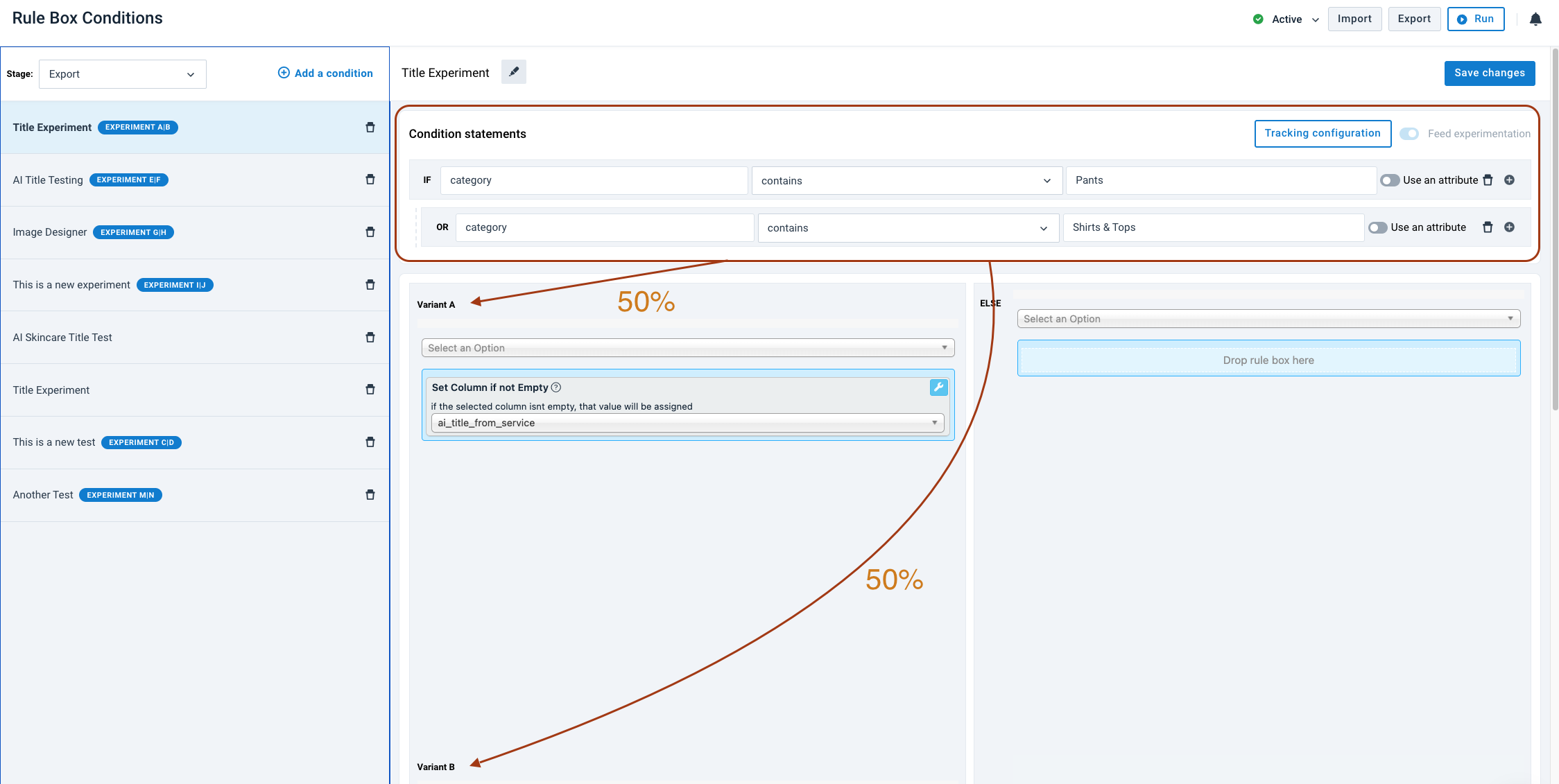
After selecting a product subset, the platform automatically assigns 50% of eligible products to Variant A and 50% to Variant B. It also ensures that they always remain in the same variant groups. Teams can then apply different feed rules, content, or attributes to each variant and compare performance.
3. Test a single variable
Apply one change to measure its impact clearly. Examples include:
- Product title variations
- AI-generated descriptions
- Product imagery
- Custom labels
- Product taxonomy structures
- Pricing display strategies
Testing one variable at a time helps isolate what is actually driving performance improvements.
4. Measure performance
Performance can be analyzed using existing analytics and advertising platforms, such as Google Analytics 4 (GA4), Google Ads, or Meta Ads Manager. Because results are measured within tools teams already trust, there is no need to learn a new reporting system.
5. Scale what works
Once results reach statistical significance, winning strategies can be rolled out across the broader catalog with greater confidence.
5 feed experiments worth running right now
Here are five high-impact experiments enterprise brands should consider.
1. Product title optimization
Product titles remain one of the most influential feed attributes across advertising channels, marketplaces, and, increasingly, AI-powered shopping experiences.
A common test is:

The hypothesis is simple. Does a brand-first title structure perform better than a feature-first structure? Or, does including additional descriptive context improve visibility and engagement?
This experiment can be particularly valuable for brands investing in Google Shopping, marketplace advertising, and AI-driven product discovery. Primary metrics to monitor:
- CTR
- Conversion rate
- ROAS
- Impression share
2. AI-generated descriptions vs. existing copy
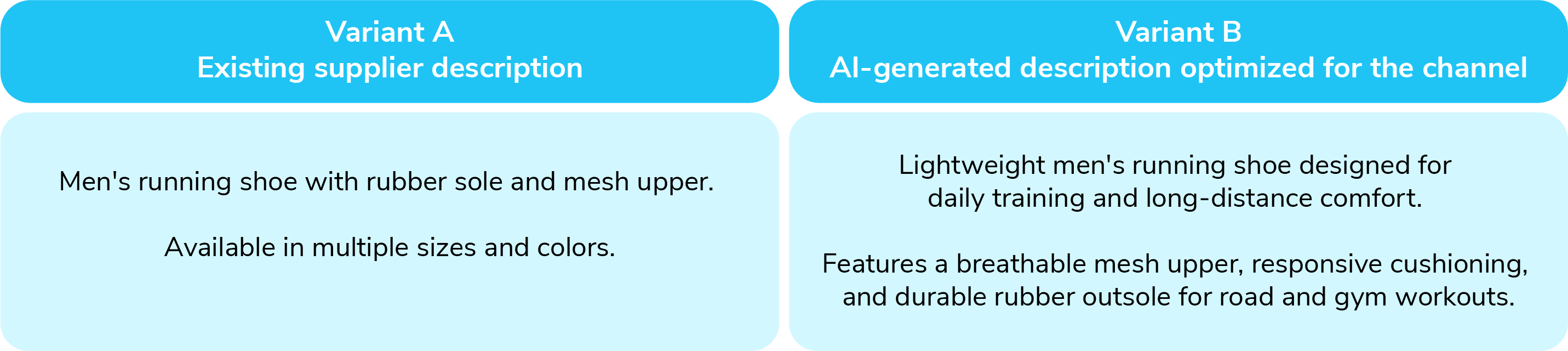
AI-generated product content is rapidly becoming part of ecommerce operations. But not every AI-generated description performs better than human-written copy.
Rather than rolling AI-generated content across an entire catalog, organizations can compare:
It's also one of the safest ways to accelerate AI adoption while minimizing risk.
💡 Using AI-generated content? Pair Feed Experimentation with AI Enrich
Create AI-generated product descriptions, highlights, Q&A pairs, and use-case tags with Productsup AI Enrich, then use Feed Experimentation to measure their impact before rolling them out across your catalog.
Learn more about AI Enrich →3. Lifestyle images vs. studio photography
Images often have a direct impact on click-through performance. Some categories benefit from clean product photography, while others perform better when products are shown in real-world use cases. For example:

The outcome frequently varies by category, audience, and channel. Rather than assuming one approach is universally better, experimentation provides measurable evidence.
4. Promotional pricing strategies
How you present your product’s price can influence shopper behavior just as much as the price itself. One common experiment involves testing:

5. Custom label strategies
Custom labels often influence bidding, segmentation, and campaign structure. Examples include:
- Bestsellers
- High-margin products
- Seasonal products
- Promotional products
A feed experiment can compare different labeling strategies to understand which approach drives stronger performance and more efficient advertising spend.
For performance marketing teams, this type of experimentation often uncovers optimization opportunities that are difficult to identify through traditional reporting alone.
Why successful Feed Experimentation starts with segmentation
The value of an experiment depends on the audience you're testing. Testing a feed change across an entire catalog can make results difficult to interpret. The more targeted the product group, the more meaningful the insight.
Built on top of Productsup rule box conditions, Feed Experimentation allows teams to define precise product subsets based on category, brand, price, availability, and other attributes before launching a test.
For instance, instead of testing AI-generated descriptions across an entire catalog, a retailer could focus on:
- Category = Running Shoes
- Price > $100
- Brand = Brand X This makes experiments more relevant, results easier to interpret, and rollout decisions more confident.
New to Productsup rule boxes?
Learn how our rule box conditions help teams segment products and create more targeted feed optimization workflows.
Learn more →Managing multiple client feeds? Read our detailed blog on feed management for agencies to learn how agencies can standardize optimizations and prepare client catalogs for AI-powered product discovery.
While Feed Experimentation remains a capability gap across much of the market, Productsup brings testing, feed optimization, AI-powered enrichment, and performance measurement together in a single platform.
Combined with AI Data Services and 2,500+ channel integrations, brands can enrich product content, validate changes, and syndicate high-performing product data across advertising channels, marketplaces, retailers, and emerging AI-powered commerce destinations such as ChatGPT and Perplexity.
Ready to see Feed Experimentation in action? Book a demo
FAQs
Yes, Feed Experimentation is included as part of the Productsup platform and is available to all customers at no additional cost.
Productsup Feed Experimentation supports up to 13 simultaneous experiments, allowing you to test multiple hypotheses across different product segments across different product segments and evaluate results independently.
While the ideal duration depends on product volume and traffic, most experiments should run for at least 2-3 weeks to gather enough data and reach statistically meaningful results.
Feed Experimentation uses UTM parameters to help track performance within existing analytics and advertising platforms. You can analyze results in tools, such as Google Analytics 4 (GA4), Google Ads, and Meta Ads Manager, without relying on a separate reporting environment.
Yes, Feed Experimentation is particularly useful for validating AI-generated descriptions, product highlights, attribute enrichments, and other AI-powered content.
About the author