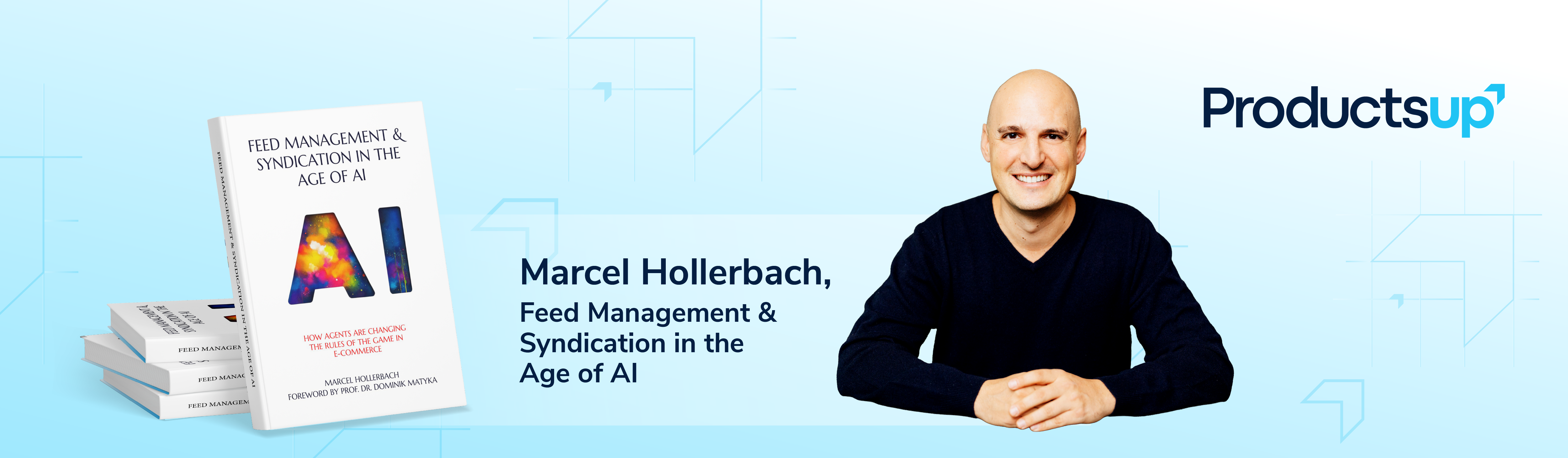






AI is everywhere in business headlines. But behind the hype, many retailers are struggling to turn ambitious promises into real results. Why? The data.
“AI can’t generate magic out of thin air; it can only work with what you give it.” says Marcel Hollerbach, CIO of Productsup.
That realization sparked Marcel’s new book, Feed Management & Syndication in the Age of AI. It’s not a technical manual, but a candid, story-driven look at how AI is reshaping ecommerce, from advertising shifts to agentic commerce, and what brands must do to keep up.
From TikTok outpacing Google to the future of agentic checkout, here’s Marcel Hollerbach’s hot takes on where the industry is headed.
1. What inspired you to write this book now?
Marcel: The idea really came from countless conversations with customers, partners, and even our own team. People kept asking the same big questions, and I realized there wasn’t a single place I could point them to for clear answers. Since not many are working right at the intersection of product data, performance advertising, and AI, I felt a responsibility to capture my observations and learnings. Writing the book was my way of creating that “go-to” resource and helping everyone prepare for what’s just around the corner.
2. AI has become such a buzzword. How is it really changing product information?
Marcel: For years, product information was like a warehouse: static, structured, and kind of dusty. AI changes that completely. It can transform the same product feed into personalized, context-aware, even conversational content.
You see, suddenly, a sofa isn’t just “blue, fabric, 3-seater”, it’s “a deep-blue couch that fits perfectly in small apartments and hides coffee stains.” That’s a huge shift. But here’s the catch: if your data is inconsistent or incomplete, AI just multiplies the chaos.
📘 Go deeper: Download Feed Management and Syndication in the Age of AI
👉[Get the book]3. You mention TikTok outpacing Google. What does that tell us about advertising?
Marcel: It basically tells us that attention is a moving target. Google was the front door to the internet. Now, people are discovering products on TikTok before they ever type a search.
The message for advertisers is clear: don’t get too comfortable. Feeds need to be agile enough to adapt to the next platform, whether that’s TikTok today or something we haven’t even heard of yet.
4. One of the boldest ideas in the book is ‘agentic checkout.’ What do you mean by that?
Marcel: Think about how you shop today. Increasingly, the decision and the purchase happen on the platform where you discover the product, not on a retailer’s website. With AI agents recommending and facilitating that checkout, the feed becomes the product page.
With agentic checkout, the data is the storefront.
5. Do you have a “tech pet peeve” that drives you crazy?
Marcel: Haha..honestly? Printers. It’s 2025, and I still can’t connect to one without trouble. I just bought a new one, and every third time it needs a reboot. I hope that AI makes printing obsolete altogether — problem solved! 😉
6. Which myth about AI and ecommerce do you wish people would finally stop believing?
Marcel: That AI can fix bad product data. It can’t. If your product copy is poor or your data is inconsistent, AI won’t magically solve it. What it can do is make the work easier, like speeding up workflows, simplifying UIs, and sparking creativity. So, there’s no skipping the hard work: the foundation has to be solid first.
7. You talk about AI agents in the book. How does that idea connect to what Productsup is building?
Marcel: I describe AI agents as autonomous systems that can act on your behalf. The idea is to show how AI can move from being a tool you use to a collaborator that helps you manage and scale complex operations. In the book, I wanted to illustrate how this shift changes the way we work with data and frees people up to focus on strategy and creativity!
8. If you could give every retailer just one AI prompt to use tomorrow, what would it be?
Marcel: Easy: “Turn this product description into three benefit-led bullet points for a consumer who has never heard of the brand.” It forces AI to cut the fluff, spotlight value, and make the product instantly relatable. You’d be surprised how much better that performs.
I’ve included a library of ready-to-use prompts in the book, everything from product descriptions to color normalization. It’s basically a starter kit for anyone who wants to test AI on real product data.
9. Fast-forward five years: where do you see this going?
Marcel: We’re still in the “steam engine” phase of AI — the electricity moment is coming. I believe we’ll see fully autonomous shopping agents, marketplaces that look nothing like today’s, and entirely new business models.
Concepts like MCP and A2A are going to be critical. MCP will be the new infrastructure for how product data flows, and A2A (agent-to-agent commerce) will redefine transactions. The brands that prepare their feeds today will be ready when those models become reality.
10. If readers take away one thing from your book, what should it be?
Marcel: That product data is your biggest competitive asset in the age of AI. Everyone talks about customer data, and yes, that’s important. But if your product feed is broken, none of your marketing, your ads, or even your AI investments will pay off.
Fix your feeds first, that’s the new rule of the game.
That’s a wrap
Whether you’re curious about agentic checkout or looking for practical AI prompts, this is a must-read. It’s a part guide, part sneak peek into the future, and even part storybook (yes, there’s a children’s tale in there).
👉 Download the book to see for yourself.
About the author
