






From Alexa+ alerts to AI shopping guides, Prime Day 2025 was a masterclass in how today’s consumers use AI to shop smarter. Here’s what brands need to know.
Welcome to the new age of AI-shopping
Prime Day 2025 has officially wrapped up, and this year, shoppers brought more than wishlists and credit cards; they brought AI copilots.
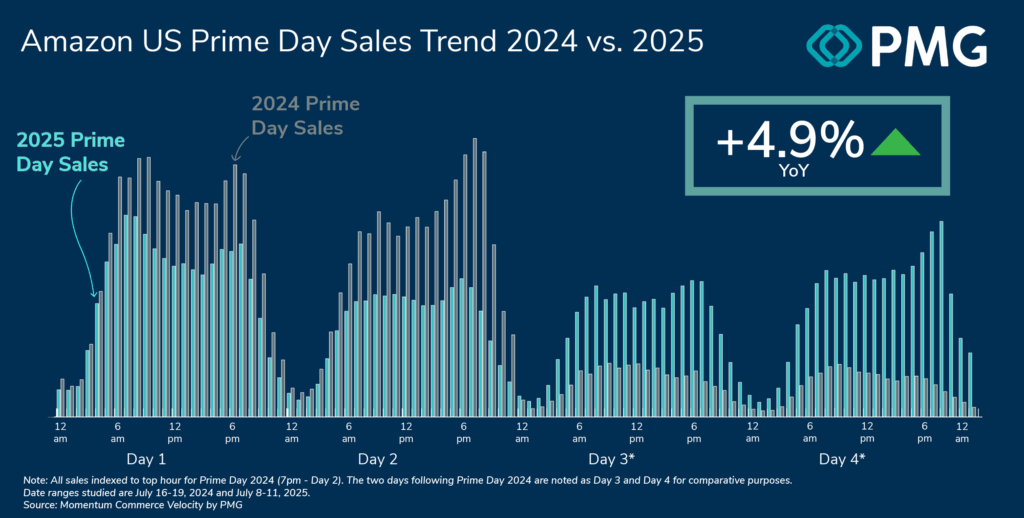
With voice-activated deal trackers, smart shopping guides, and GPT-powered assistants, consumers turned Amazon Prime Day into a personalized, precision-targeted experience. According to Adobe, consumers leaned heavily on generative AI during Prime Day 2025, and not just within Amazon’s ecosystem, but across the wider web. Traffic from generative AI tools to US retail sites surged 3,300% year-over-year, as consumers turned to AI chatbots and browsers to research products, compare prices, and spot real deals.
Source
For retailers, Prime Day 2025 brought huge online sales—$24.1 billion spent in the US, marking 30.3% year-over-year growth. That’s nearly twice as much as Black Friday 2024, making it one of the biggest shopping events ever. So, what did Prime Day shopping behavior look like behind these numbers? And more importantly, what learnings can you take from it to stay ahead of future sales events like Black Friday and beyond?
Get to know how AI-driven consumers think and act
Before diving into the AI tools and strategies that shaped Prime Day, let’s start with the people behind the purchases. Meet the evolving consumer personas that defined Prime Day 2025.
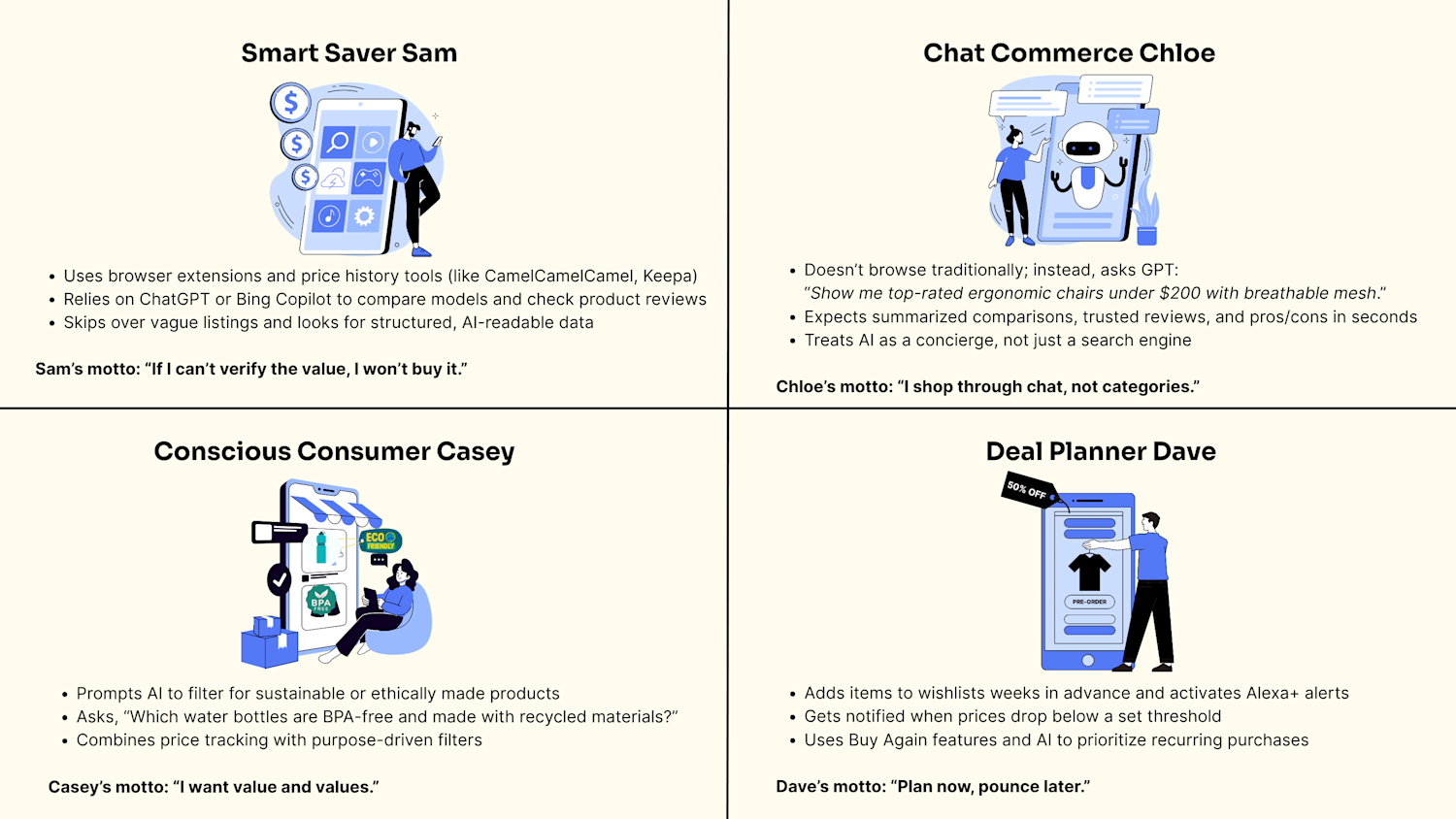
As you can see, regardless of who your next customer is, they may never see your product detail page unless their AI assistant recommends you to the shortlist.
Simplify your Amazon success with Productsup
Easily manage and optimize your Amazon listings across Seller and Vendor Central with Productsup’s seamless integration. Automate product feeds, stay compliant, and scale globally—all from one platform.

The AI shopping arsenal of 2025: What tools did consumers use?
Amazon offered new tools this year, but shoppers didn’t stop there. They mixed and matched their AI stack like seasoned pros.
Amazon’s AI tools
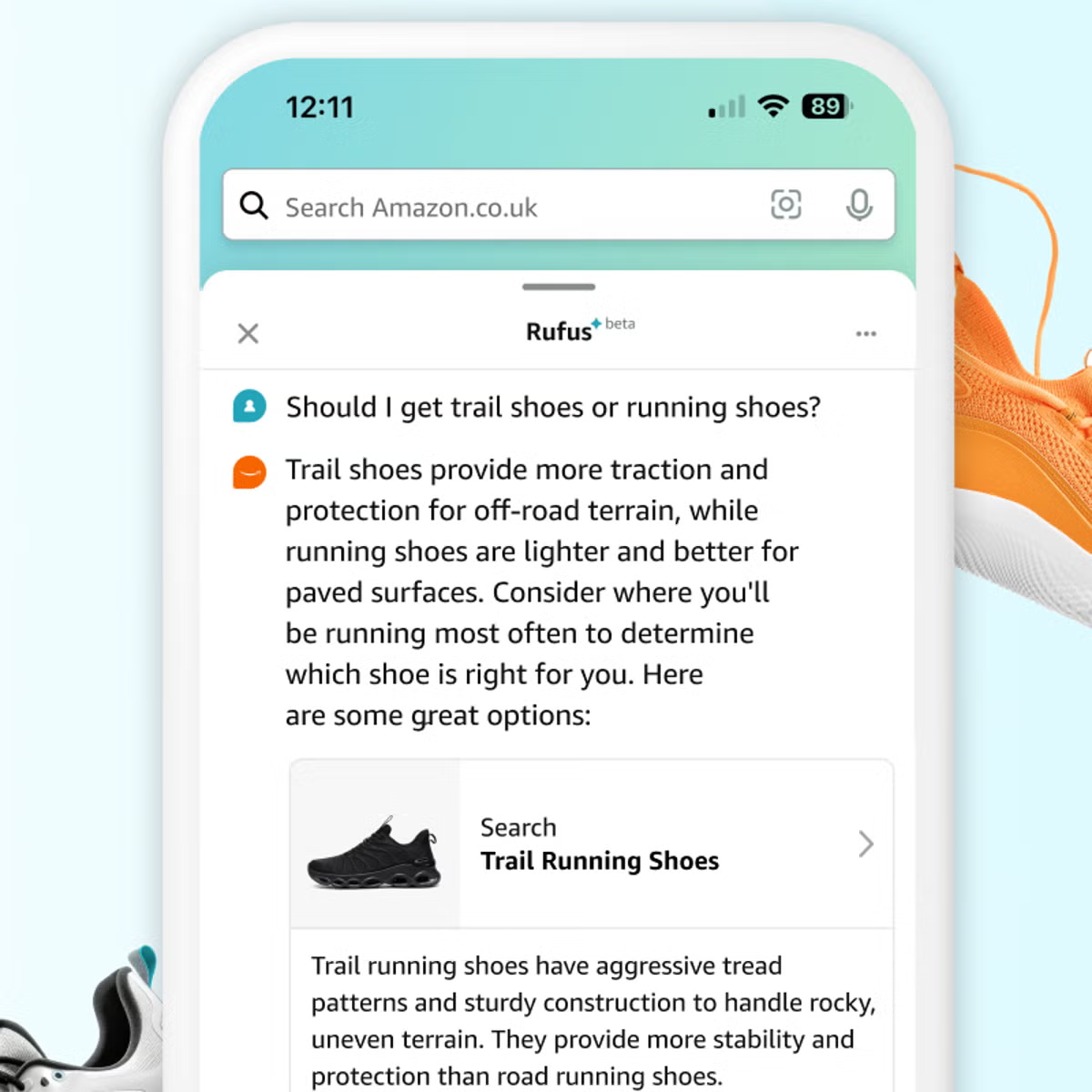
1. Rufus: The generative AI shopping assistant
Launched earlier last year, Rufus lets Prime members ask natural-language questions like:
- “When does Prime Day start?”
- “What’s the best 65-inch TV for sports under $1,000?”
- “Show me the best material travel backpack.”
It returns real-time product matches based on price, reviews, and specs without requiring shoppers to browse. Here’s an example of how Rufus helps customers:
Source: aboutamazon.com
💡Actionable takeaway: Use clear, benefit-led bullet points and structured attributes to get surfaced by tools like Rufus.
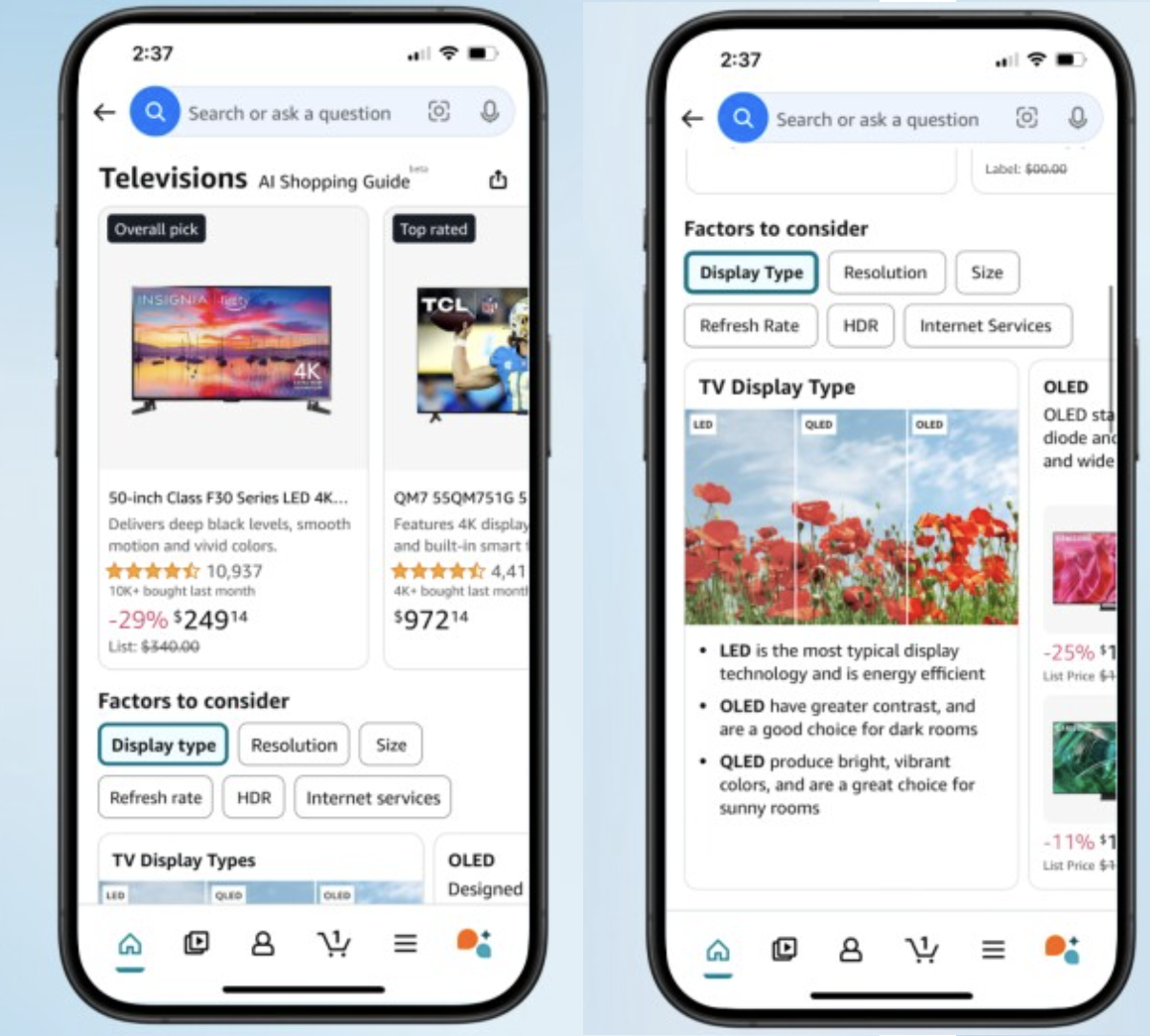
2. Shopping guides powered by AI
Consumers could explore product categories via smart guides, especially in decision-heavy categories like home office, skincare, or tech. These AI-generated pages offer:
- Side-by-side comparisons
- Quick explanations of jargon (e.g., “IPS vs OLED”)
- Editor-style picks without the bias
Source: aboutamazon.com
💡Actionable takeaway: Appearing in the top three positions of these guides = massive exposure. Focus on optimizing feed quality and user reviews.
3. Interests and custom prompts
With Amazon’s AI-powered Interests feature, users simply enter their hobbies, such as gaming, gardening, or home decor, and receive a personalized stream of curated deals. For example, a home decor enthusiast who added “interior design” related interests in the feature may have seen exclusive deals on boho-style throw pillows, smart ambient lighting, wall-mounted planters, or minimalist accent furniture products tailored to their design aesthetic and preferences.
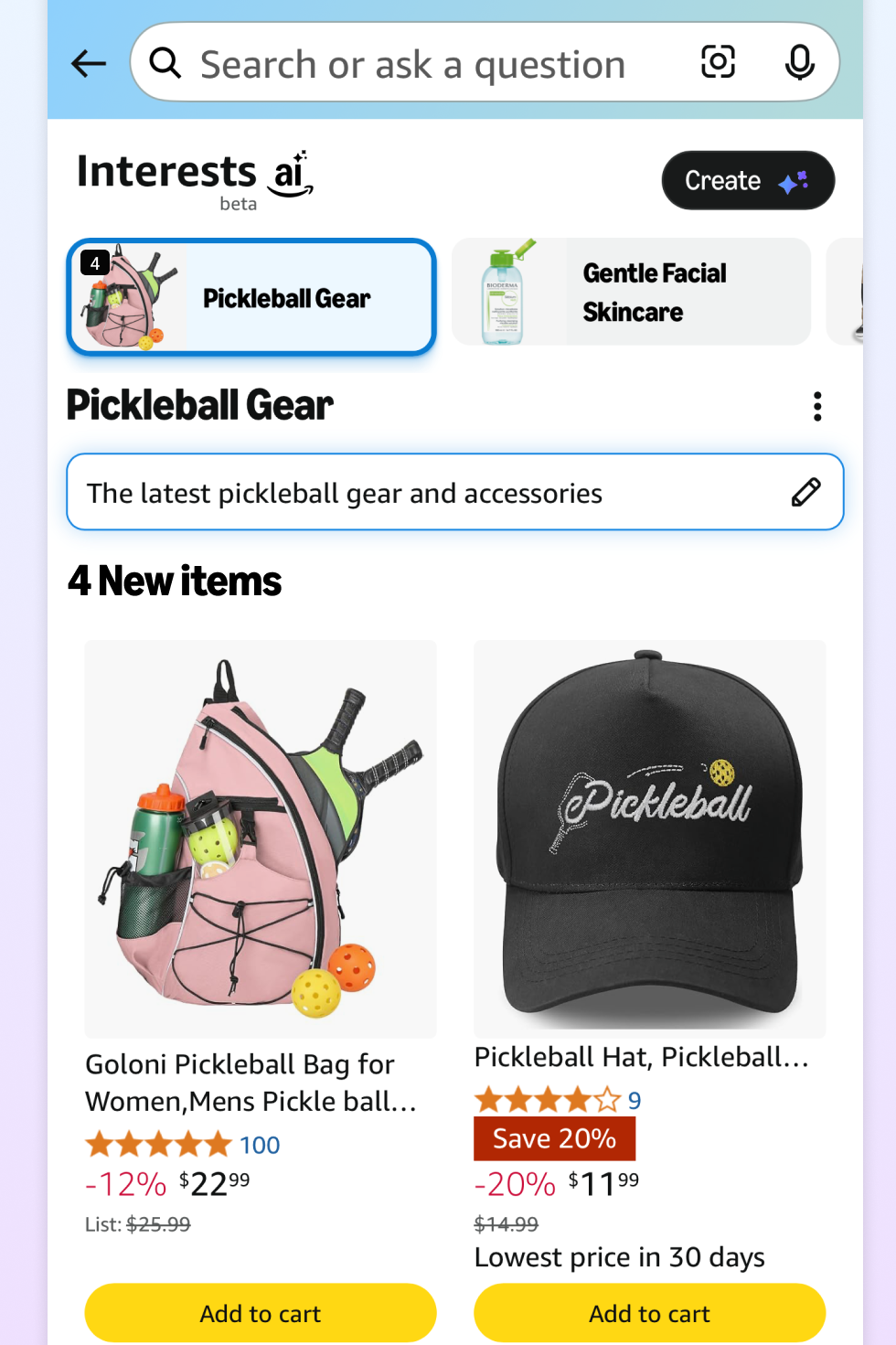
Source: aboutamazon.com
💡Actionable takeaway: Align your products with lifestyle-driven tags and seasonal themes. Position your listing under passion points like “eco-conscious kitchen upgrades” or “home gym essentials for runners” to surface in more personalized AI recommendations.
4. Hear the highlights: Audio summaries for smarter shopping
Amazon’s Hear the Highlights brings product detail pages to life with AI-generated audio summaries that narrate key features, customer insights, and product benefits. Designed for multitaskers and auditory learners, it provides a hands-free way to quickly evaluate products. While currently limited to select listings, Amazon plans to expand this feature across more pages in the coming months.
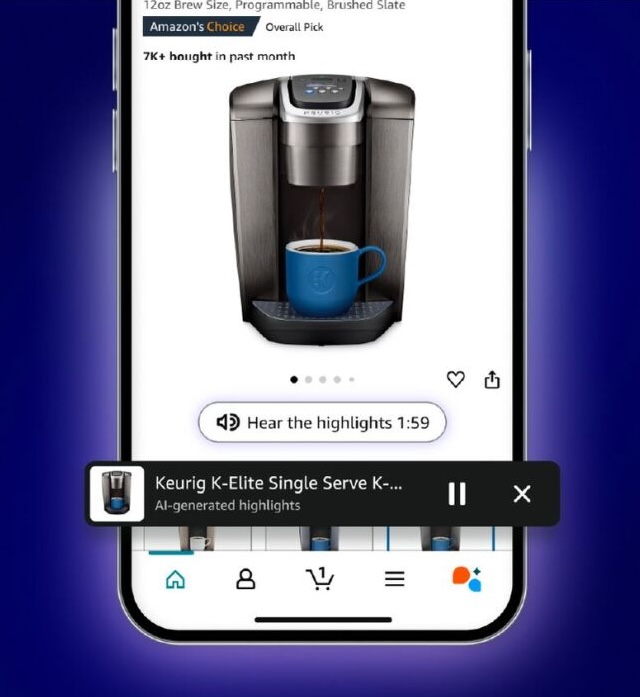
Source: aboutamazon.com
💡Actionable takeaway: Make your listings audio-ready by adding clear, benefit-focused copy and maintaining strong reviews, as these influence what the AI will voice. Focus on structured data to increase eligibility as the rollout grows.
5. Lens: Point, snap, and shop visually
Amazon Lens made it easy for shoppers to find products using just a photo, screenshot, or barcode. Instead of typing out search terms, users could simply snap a picture of an item they liked—whether it was a lamp in a friend’s living room or shoes spotted online—and get instant results with similar options on Amazon. With the “Today’s Deals” filter, it became a quick way to discover Prime Day discounts on the spot.
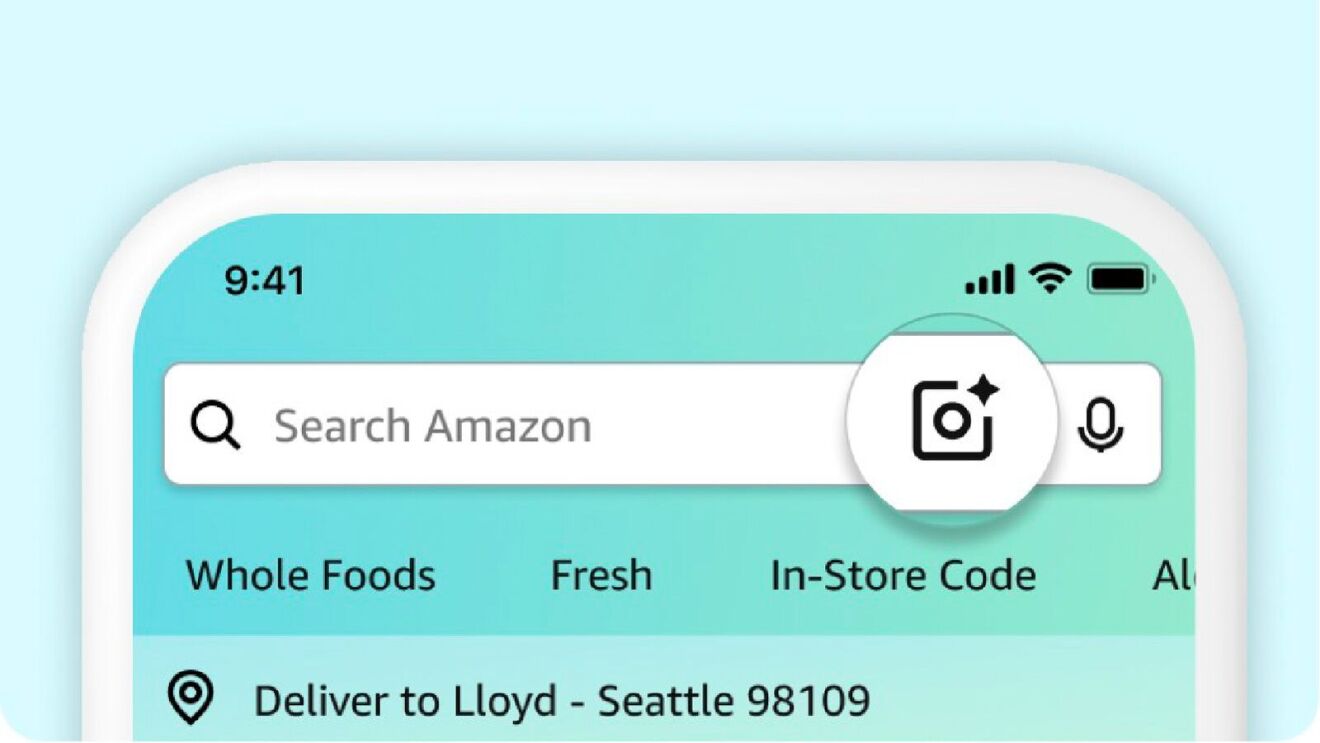
Source: aboutamazon.com
💡Actionable takeaway: Use clear, high-quality images and accurate product tags to improve visibility in visual searches. Well-optimized visuals help your products show up more often when shoppers use Amazon Lens.
6. Alexa+ smart alerts
Far beyond setting timers or playing music, Alexa+ has evolved into a real-time Amazon shopping companion, proactively helping consumers hunt down the best Prime Day bargains without ever touching a screen. Here’s what Alexa+ enabled this year:
- Wishlist deal tracking: Users added products weeks in advance, and Alexa+ kept tabs on price drops. The moment an item hit their preferred threshold, they received an alert via app, device, or even voice.
- Essential price drops: Alexa+ reminded shoppers when staple items they frequently purchase went on sale, making replenishment both timely and budget-friendly.
- Voice-activated deal search: Personalized responses to spoken queries like “best smart home deals.”
- Proactive recommendations: Deal suggestions based on past behavior and cart activity.
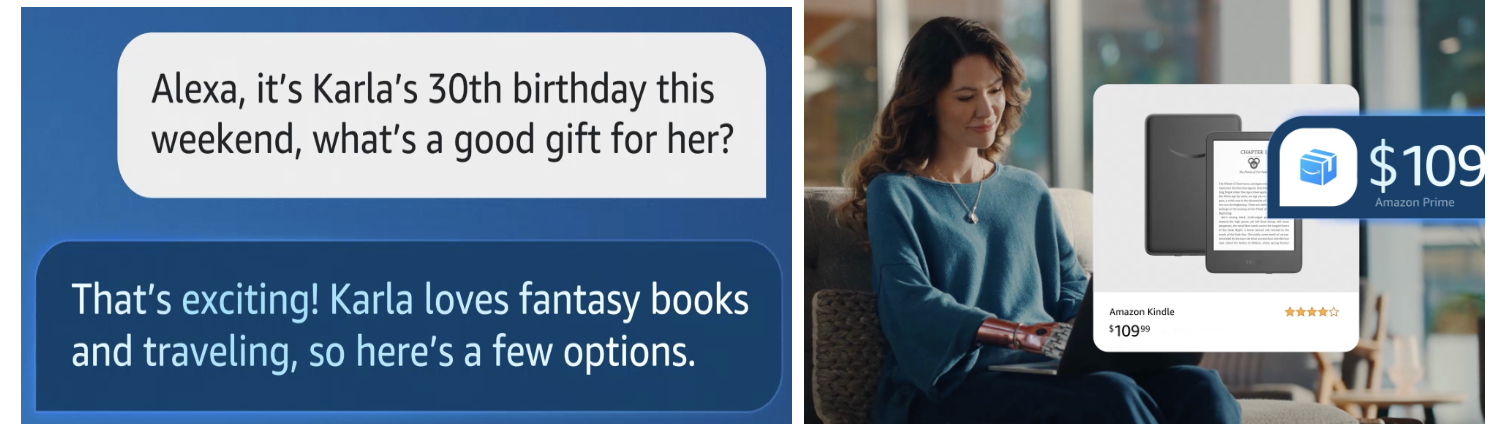
Source: aboutamazon.com
💡Actionable takeaway: Ensure your deals are time-sensitive, clearly framed, and personalized because Alexa+ only surfaces the most relevant and high-value promotions.
Beyond Amazon: Off-platform AI tools to outsmart Prime Day
While Amazon’s native AI tools, such as Rufus and Alexa+, played a central role, a large portion of Prime Day 2025 shoppers also turned to external AI platforms and tools to plan, compare, and validate their purchases.
These tools gave consumers more control, more transparency, and smarter decision-making, fundamentally changing how and where brands must position themselves online.
Here’s a breakdown of the most popular off-Amazon AI tools used this year:
1. ChatGPT, Bing Copilot, Gemini (formerly Bard): The AI shopping concierges
Consumers didn’t just browse categories; they chatted their way to decisions. Many used generative AI assistants like ChatGPT, Bing Copilot, and Google Gemini to:
- Ask for product comparisons (“Compare Bose QuietComfort vs Sony WH-1000XM5 for travel”)
- Generate curated lists (“Best Prime Day deals on home office furniture under $300”)
- Validate product claims using external reviews or Reddit opinions
Source
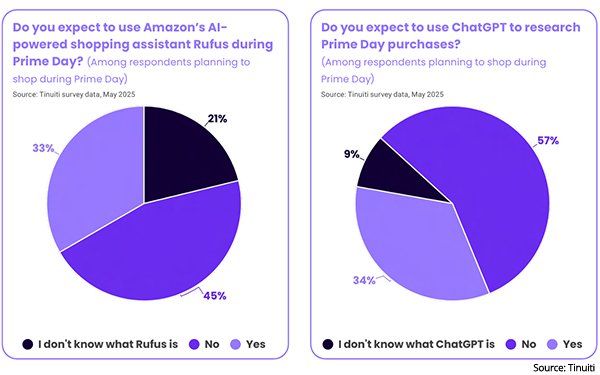
According to Tinuiti’s 2025 Prime Day study, AI tools are emerging as the preferred way to explore products. Thirty-four percent (34%) of shoppers said they planned to use ChatGPT to research their purchases, slightly edging out the 33% who expected to rely on Amazon’s own AI assistant, Rufus.
💡Actionable takeaway: These AI tools summarize web content and reviews from multiple platforms. If your product isn’t clearly represented across public channels (e.g., blogs, Reddit, YouTube, etc.), it will likely get left out of AI-generated suggestions.
2. Price tracking tools: No more “fake” deals
Consumers are increasingly skeptical of inflated discounts. Tools like CamelCamelCamel, Keepa, Honey, Capital One Shopping, and Idealo help shoppers view a product’s price history over weeks or months. A supposed “45% off” deal is quickly exposed if the product was only marked up days before.
During Prime Day 2025, these sites saw a spike in traffic as users monitored prices and deals.
💡Actionable takeaway: Be transparent. Inflated pricing tactics can damage long-term trust and brand reputation when exposed by AI tools.
3. Visual and voice-based discovery tools
Shoppers also used Google Lens, Pinterest Lens, and mobile visual search to scan screenshots, product photos, or even real-life items and instantly find similar products online (and often at better prices.)
In fact, Pinterest credited AI-powered personalization for the company’s 16% revenue growth and emphasized that in 2025, they are doubling down on visual search using advanced multimodal AI to deliver a new level of user personalization. Many of these searches came from users looking for home decor, fashion, and lifestyle items they encountered on TikTok or Instagram. At the same time, voice assistants like Siri and Google Assistant were used to:
- Ask for price comparisons
- Add items to carts across platforms
- Trigger reorders from past purchases
💡Actionable takeaway: Optimize product images with rich alt-text, use high-resolution visuals, and ensure visual variants (e.g., colors, angles) are well-tagged. AI visual search depends heavily on this metadata.
4. Reddit, TikTok, and YouTube reviews: AI-pulled social validation
Generative AI assistants often pull content from open web sources, especially social platforms like:
- Reddit threads (r/BuyItForLife, r/AmazonDeals)
- YouTube reviews and comparison videos
- TikTok deal roundups (#primedayfinds had 100M+ views during the week)
Shoppers prompted ChatGPT with:
“Summarize Reddit feedback on the best budget robot vacuums for Prime Day.” “What do YouTubers say about the new Kindle Scribe?”
These prompts helped bypass influencer noise and get straight to trusted, aggregated opinions.
💡Actionable takeaway: Make sure your product is present and positively reviewed on platforms where AI models pull user-generated content. A great Amazon listing isn't enough if you're invisible elsewhere.
From search to sale: Everything you need to know about Reddit Ads
Learn how to reach high-intent audiences, build authentic campaigns, and turn Reddit’s niche power into real results.
Watch now →Final thoughts: How do you win over AI-enabled shoppers?
Prime Day 2025 showed us a new pattern: AI tools outside Amazon are now just as influential as Amazon’s own ecosystem. Shoppers are blending platforms, verifying claims, and customizing their journeys across channels.
For brands and retailers, this means:
- You need visibility far beyond Amazon marketplaces.
- Your product content must be consistent and accurate across every channel.
- Your brand should be ready to show up when a consumer asks an AI assistant for help.
So, are your product feeds ready for the AI shopping revolution?
Whether it’s optimizing product data for voice search, structuring feeds for generative AI discovery, or syndicating content across hundreds of platforms, Productsup ensures your products stand out in the modern commerce landscape.
Learn more about Productsup’s AI and automation features by booking a free consultation with our team to see how we can help your brand become AI-visible, cross-channel consistent, and future-ready.
Explore more resources:
- [Overview] Productsup for retailers
- [Webinar] Capture and go! How AI is changing product content
- [Guide] The ultimate Amazon Prime Day checklist
FAQs
Prime Day 2025 took place from July 8 to July 11, running for 96 hours—double the traditional two-day span.
While Amazon hasn’t released its official sales figures yet, US online spending during Prime Day 2025 hit $24.1 billion, a 30.3% year-over-year increase. Data shows over 154,800 Prime Day orders were tracked, with an average order value of $53.34.
While Amazon hasn’t released a definitive list yet, Adobe identified the following products as some of the top-selling items during the Prime Day event: Kids’ apparel (up 250% compared to average daily sales in June 2025), Home security products (up 185%), Refrigerators & freezers (up 160%), Games (up 160%), Headphones & speakers (up 155%), and more.
Yes, but shoppers also leveraged price-tracking tools to confirm true savings. These tools saw a significant surge in usage, indicating widespread concern and use of validated pricing.
Shoppers used AI tools like Rufus, Alexa+, and ChatGPT to personalize their Prime Day experience and track real-time deals. Adobe reported a 3,300% year-over-year increase in traffic to US retail sites from generative AI tools during the event.
After Prime Day, Amazon typically holds Prime Big Deal Days in October, mirroring the summer event in scope and scale.
Optimize product listings with rich content and keywords, ensure inventory is stocked and synced early, leverage AI tools for pricing and content, and use data insights from past events to fine-tune targeting and promotions.
About the author
